How to Install Nginx, MySQL, PHP (LEMP Stack) on Ubuntu 26.04
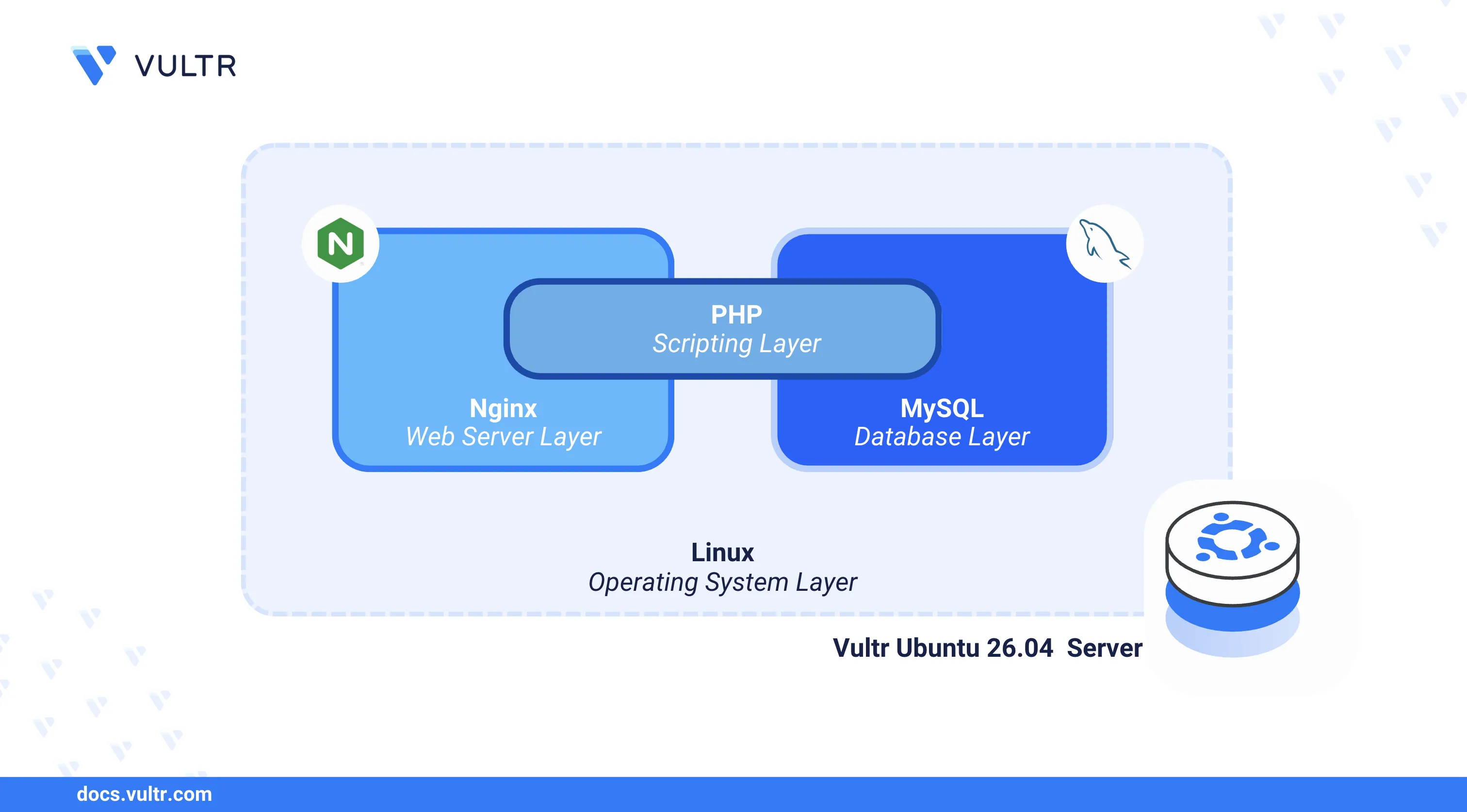
LEMP is a web application stack consisting of Linux, Nginx, MySQL, and PHP. Nginx handles HTTP requests and serves static content, MySQL stores and manages relational data, and PHP processes server-side logic to generate dynamic web pages. Together, these components form a complete platform for hosting web applications such as content management systems, e-commerce platforms, and custom web services.
This article explains how to install the LEMP stack on an Ubuntu 26.04 server. It covers setting up each component, configuring Nginx to process PHP requests through PHP-FPM, securing the server with firewall rules and a Let's Encrypt SSL certificate, and testing the stack with a sample PHP application that queries a MySQL database.
Prerequisites
Before you begin, you need to:
- Have access to an Ubuntu 26.04 server instance as a non-root user with sudo privileges.
- Have a domain A record pointing to the server's public IP address. For example,
app.example.com.
Install Nginx
Nginx is available in the default Ubuntu 26.04 APT repositories. The following steps install the web server and verify that the service is running.
Update the APT package index.
CONSOLEInstall Nginx.
CONSOLEEnable Nginx to start automatically at boot time.
CONSOLEStart the Nginx service.
CONSOLEVerify that Nginx is active and running.
CONSOLEThe output should display
active (running), confirming that Nginx is operational.
Install MySQL
MySQL is included in the default Ubuntu 26.04 repositories. The following steps install the database server, enable the service, and run the secure installation script to harden the default configuration.
Install the MySQL server package.
CONSOLEEnable MySQL to start automatically at boot time.
CONSOLEStart the MySQL service.
CONSOLEVerify that MySQL is active and running.
CONSOLEThe output should display
active (running), confirming that the MySQL server is operational.Run the MySQL secure installation script to remove insecure defaults.
CONSOLERespond to each prompt as described below:
- VALIDATE PASSWORD COMPONENT: Enter Y and press Enter to activate password validation.
- Password Validation Policy: Enter 2 to require strong passwords.
- Remove anonymous users?: Enter Y to delete anonymous database accounts.
- Disallow root login remotely?: Enter Y to restrict root access to the local server.
- Remove test database and access to it?: Enter Y to drop the default test database.
- Reload privilege tables now?: Enter Y to refresh the privilege tables and apply all changes.
Open the MySQL server configuration file.
CONSOLEAdd the following directive under the
[mysqld]section to activate themysql_native_passwordauthentication plugin.INISave and close the file.
Restart MySQL to load the updated configuration.
CONSOLEAccess the MySQL console as the
rootsystem user.CONSOLESet a strong password for the root account. Replace
your_strong_passwordwith a secure password that meets your validation policy.SQLReload the privilege tables to apply the password change.
SQLExit the MySQL console.
SQL
Install PHP
PHP-FPM (FastCGI Process Manager) enables Nginx to process PHP scripts by forwarding requests through a Unix socket. The following steps install PHP, PHP-FPM, and the MySQL extension required for database connectivity.
Install PHP, PHP-FPM, and essential modules.
CONSOLEThe command installs the following packages:
php-fpm: Manages PHP worker processes for handling web server requests.php-mysql: Enables PHP to connect to MySQL databases.php-cli: Provides the PHP command-line interpreter for running scripts in the terminal.
Confirm the installed PHP version.
CONSOLEYour output should be similar to the one below:
Enable PHP-FPM to start automatically at boot time.
CONSOLEStart the PHP-FPM service.
CONSOLEVerify that PHP-FPM is active and running.
CONSOLEThe output should display
active (running), confirming that PHP-FPM is operational.
Set Up Firewall Rules
Uncomplicated Firewall (UFW) is active by default on Ubuntu 26.04. The following steps open ports for HTTP and HTTPS traffic so that Nginx can serve web applications.
Allow HTTP traffic on port
80.CONSOLEAllow HTTPS traffic on port
443.CONSOLEVerify the active firewall rules.
CONSOLEYour output should be similar to the one below:
Configure Nginx with PHP-FPM
Nginx does not process PHP scripts natively. It forwards PHP requests to PHP-FPM through a Unix socket for execution. The following steps create a virtual host configuration that connects Nginx to PHP-FPM and serves a PHP application.
Unlink the default Nginx virtual host configuration.
CONSOLECreate a new virtual host configuration file. Replace
app.example.comwith your actual domain name.CONSOLEAdd the following configuration to the file.
INISave and close the file.
Within the configuration:
server_name: Defines the domain that triggers this virtual host.root: Sets the directory from which Nginx serves files.location ~ \.php$: Matches requests ending in.phpand forwards them to PHP-FPM.include snippets/fastcgi-php.conf: Loads the predefined FastCGI directives for PHP processing.fastcgi_pass: Specifies the PHP-FPM Unix socket path for communication.
Enable the virtual host by creating a symbolic link.
CONSOLETest the Nginx configuration for syntax errors.
CONSOLEThe output should confirm that the configuration syntax is ok and the test is successful.
Restart Nginx to activate the virtual host.
CONSOLE
Secure the Server with SSL
SSL certificates encrypt communication between the client browser and the Nginx web server over HTTPS. The following steps install Certbot and generate a trusted Let's Encrypt SSL certificate for your domain.
Install the Certbot Let's Encrypt client and the Nginx plugin.
CONSOLEGenerate an SSL certificate for your domain. Replace
app.example.comwith your actual domain name.CONSOLEFollow the on-screen prompts to complete the certificate generation. Certbot automatically updates the Nginx virtual host configuration to enable HTTPS.
Verify that the automatic renewal process is configured correctly.
CONSOLE
Test the LEMP Stack
A working LEMP stack allows PHP to query data from MySQL and return dynamic content through Nginx. The following steps create a sample database, insert a test record, and build a PHP application that retrieves and displays the data in a web browser.
Log in to the MySQL console as the
rootuser.CONSOLEEnter the root password you configured earlier.
Create a new database named
example_db.SQLCreate a database user named
example_userwith a strong password. Replacestrong_passwordwith your desired password.SQLGrant the user full privileges on the
example_dbdatabase.SQLReload the privilege tables.
SQLSwitch to the
example_dbdatabase.SQLCreate a table named
messageswith an auto-incrementing ID and a text column.SQLInsert a sample record into the table.
SQLVerify that the record exists.
SQLYour output should be similar to the one below:
Exit the MySQL console.
SQLCreate a PHP test file in the web root directory.
CONSOLEAdd the following PHP code to the file. Replace
strong_passwordwith theexample_userpassword you set earlier.PHPSave and close the file.
This script connects to the
example_dbdatabase, queries themessagestable, and displays the result as an HTML heading.Access the test page in a web browser. Replace
app.example.comwith your actual domain name.The browser displays the message Hello World from LEMP Stack, confirming that Nginx, MySQL, and PHP are working together.
Conclusion
You have deployed and secured the LEMP stack on an Ubuntu 26.04 server. Nginx serves web requests, PHP-FPM processes dynamic content, and MySQL manages the application data. This stack supports multiple virtual hosts and integrates with frameworks such as Laravel and WordPress. For more configuration options, refer to the following resources:
Tags:Ubuntu 26.04


0 Comments
Be the first to comment and share your perspective with the community.