How to Use Vultr Serverless Inference in Python
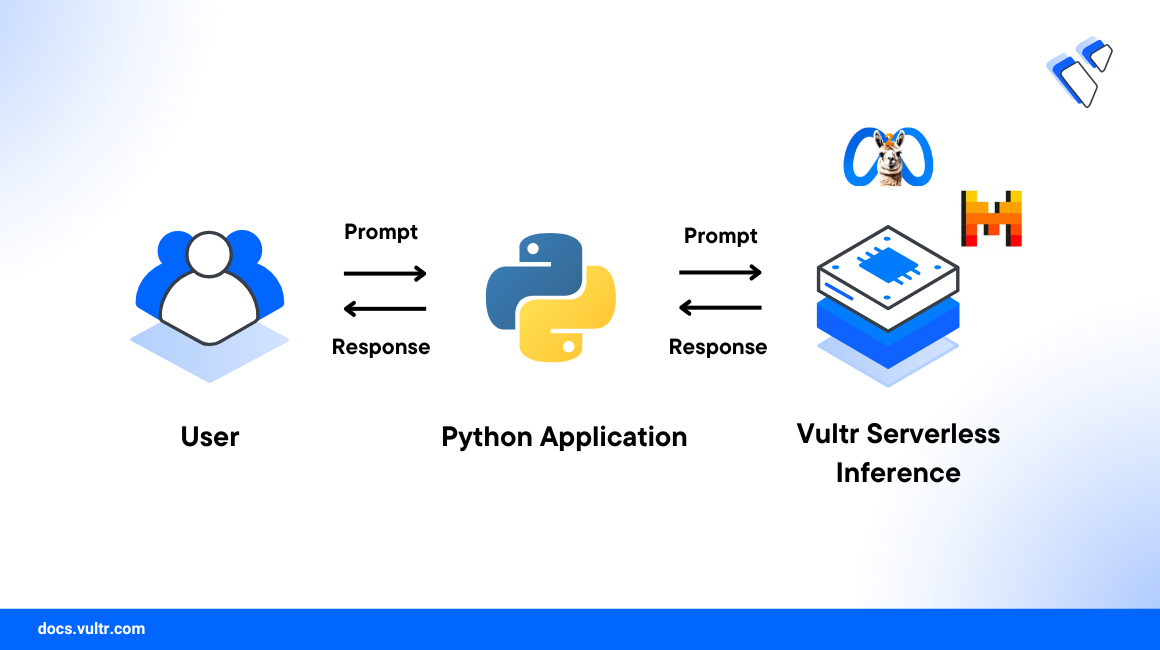
Vultr Serverless Inference allows you to run inference workloads for large language models such as Mixtral 8x7B, Mistral 7B, Meta Llama 2 70B, and more. Using Vultr Serverless Inference, you can run inference workloads without having to worry about the infrastructure, and you only pay for the input and output tokens.
This guide demonstrates step-by-step process to start using Vultr Serverless Inference in Python.
Prerequisites
Before you begin, you must:
- Create a Vultr Serverless Inference Subscription
- Fetch the API key for Vultr Serverless Inference
- Python 3.10 or later
Set Up the Environment
Create a new project directory and navigate to the project directory.
CONSOLECreate a new Python virtual environment.
CONSOLEInstall the required Python packages.
CONSOLENote
Please note that you only need to install the
openaipackage if you are using the OpenAI SDK for Vultr Serverless Inference.
Inference via Direct API Calls
Vultr Serverless Inference provides a RESTful API to run inference workloads. You can use the requests package to make the API calls.
Create a new Python file name
inference.py.CONSOLEAdd the following code to
inference.py.PYTHONRun the Python script.
CONSOLEHere, we are making a POST request to
https://api.vultrinference.com/v1/chat/completionswith the required headers and data. Themessageslist contains the list of messages for which we want to generate completions, role can be eithersystem,userorassistant, andcontentis the message content.To maintain conversation context, you can add the previous messages to the
messageslist. You can also use thestreamparameter to get real-time completions. For more information, refer to the Vultr Serverless Inference API documentation.
Inference via OpenAI SDK
If you are using the OpenAI SDK for Vultr Serverless Inference, you can use the openai package to make the API calls.
Create a new Python file name
inference_openai.py.CONSOLEAdd the following code to
inference_openai.py.PYTHONRun the Python script.
CONSOLEHere, we are using the
openaipackage to make the API calls. Themessageslist contains the list of messages for which we want to generate completions, role can be eithersystem,userorassistant, andcontentis the message content.To maintain conversation context, you can add the previous messages to the
messageslist. You can also use thestreamparameter to get real-time completions. For more information, refer to the Vultr Serverless Inference API documentation.
Conclusion
In this guide, you learned how to use Vultr Serverless Inference in Python to run inference workloads for large language models. You also learned how to use the requests package and the OpenAI SDK to make API calls to Vultr Serverless Inference. You can now integrate Vultr Serverless Inference into your Python applications to generate completions for large language models.


0 Comments
Be the first to comment and share your perspective with the community.