How to Upgrade from FreeBSD 13.0 to FreeBSD 14.0
Introduction
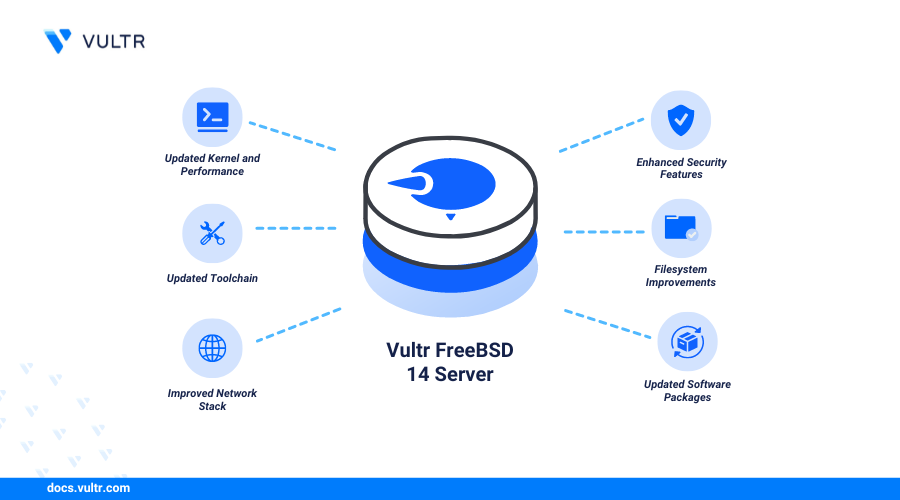
FreeBSD is an open-source Unix-like operating system known for its reliability and performance. FreeBSD 14 introduces modern features, the latest applications, and enhanced security. With each release, you can upgrade FreeBSD 14 to benefit from improvements, including an upgraded pkg package manager for easy application installation and management.
This article explains how to upgrade FreeBSD 14.0 from FreeBSD 13.0 to benefit from the latest improvements, performance, and security upgrades.
Prerequisites
Before you begin:
- Deploy a FreeBSD 13 instance on Vultr.
- Access the instance using SSH as a non-root user with sudo privileges.
- Create a snapshot to backup the instance.
Test the Compatibility of Installed Applications
Before upgrading your server to FreeBSD 14, test the compatibility of all installed applications to avoid any post-upgrade errors. Follow the recommendations below to test the compatibility of installed applications with FreeBSD 14 and verify that your server is ready for the upgrade.
Visit the FreeBSD release notes and verify any known vulnerabilities or unsupported packages.
Visit each application's documentation and verify it supports FreeBSD 14.0 to avoid post-upgrade runtime errors.
Stop any non-essential services to prevent upgrade interruptions.
Run the following
df -hcommand and verify that your server has at least2GBof free space to store the upgrade files.CONSOLEOutput:
Upgrade FreeBSD 14.0 from FreeBSD 13.0
Follow the steps below to upgrade the FreeBSD 13 server to FreeBSD 14.
Check the FreeBSD version on your server and verify that its FreeBSD 13.
CONSOLEOutput:
Update the server's package information index.
CONSOLEOutput:
Install a sample application to test the upgrade process. For example, install the Nginx webserver package.
CONSOLEOutput:
Enable Nginx to automatically start at boot.
CONSOLEOutput:
Start the Nginx service.
CONSOLEOutput:
Fetch the latest FreeBSD 14.0 upgrade information.
CONSOLEOutput:
You will receive multiple prompts similar to the ones below. Press Enter to edit each target file using the default
vieditor.Enter
:wqto save and close the file. Then, enter ACCEPT when prompted to apply the changes.Install the FreeBSD 14.0 updates information.
CONSOLEOutput:
Reboot the server to apply the FreeBSD 14.0 changes.
CONSOLEAccess the server again using SSH as a non-root user with sudo privileges.
CONSOLEInstall the FreeBSD 14.0 update files again to upgrade the server.
CONSOLEOutput:
Check the FreeBSD version on your server and verify that it's FreeBSD 14.0.
CONSOLEOutput:
Re-install the
pkgpackage manager with FreeBSD 14.0 information.CONSOLERebuild all ports and packages with the latest FreeBSD 14.0 information.
CONSOLE
Managing applications efficiently on FreeBSD is made easy with the FreeBSD package manager.
Test the Upgraded FreeBSD 14 Server
Follow the steps below to test your upgraded FreeBSD 14.0 server and verify that the sample Nginx webserver application you installed earlier runs correctly.
View all storage partitions on the server and verify that no unusual disk usage or paths exist.
CONSOLEOutput:
View all running services on the server.
CONSOLEOutput:
Test network connectivity and DNS propagation to a common site such as
google.comusing the Ping utility.CONSOLEOutput:
View the system logs to check any system errors or warnings associated with the upgrade.
CONSOLEOutput:
Restart the Nginx service and view its status to verify it's running.
CONSOLEAccess your server's public IP address using a web browser such as Chrome and verify that the default Nginx page displays.
Access other applications installed on your FreeBSD server and verify that they run correctly without any errors.
Conclusion
You have successfully upgraded your server from FreeBSD 13 to FreeBSD 14 and tested access to the installed applications. FreeBSD 14.0 offers newer packages and security enhancements, improving server reliability and performance. For more details on how to upgrade FreeBSD, visit the FreeBSD Documentation.
Tags:FreeBSD


0 Comments
Be the first to comment and share your perspective with the community.